Ancient metal printing plates
Last and First MenThe Ancient metal printing plates are durable printing blocks from the First Men, recovered beneath a shattered pylon in China. Their crowded writing, deciphered over generations, confronted the Patagonians with a history of civilization that their own legends and limited surviving knowledge could not supply. The plates turned buried material remains into a force that reshaped how a later society understood its past—and its prospects.
Discovery and material form
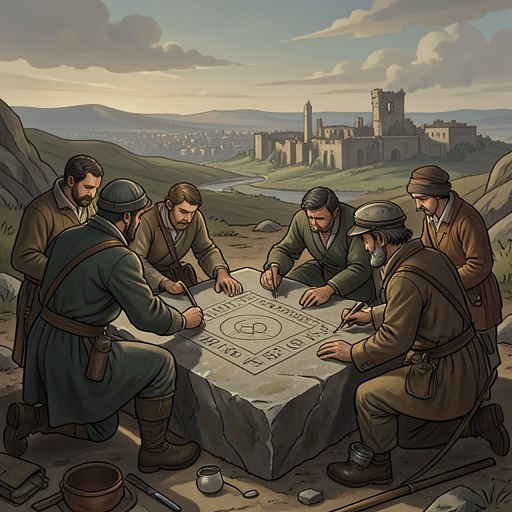
The plates were found in the basement of a shattered pylon, an ancient structure in a region where ruins had once been dismissed as freaks of nature. They were made from an immensely durable artificial element and bore crowded lines of writing. Archaeologists recognized them not as inscriptions alone but as blocks from which books had been printed a hundred thousand years earlier.
The find came as the Patagonians were beginning to develop natural knowledge and archaeology. Their homeland contained no relics of the ancient order, and they had regarded themselves as pioneers of the mind; the ruins in older regions had not yet given them a reliable account of who had built them. The plates supplied physical evidence where inherited stories and conjecture had failed.
Decipherment and historical inheritance
Further deposits were discovered after the first cache. The plates and related finds were gradually interpreted as scholars deciphered the dead language; within three centuries, the broad outline of the ancient culture had become clear. What emerged was not merely a collection of technical discoveries but the history of humanity’s rise and ruin. The Patagonians learned that the territory they had painfully won from the wild had been conquered before and then lost, and that their scattered settlements stood where an earlier civilization had once held an empire.
The new record also revised their estimate of their own achievement. Their natural knowledge had advanced little beyond pre-Newtonian Europe: they had begun to grasp scientific inquiry and shed some superstitions, but had not approached the material scale of the past. The plates thus delivered a vast inheritance of thought while making the recipients’ apparent pioneering status difficult to sustain.
Dispute over the past
The Patagonian response was not simple reverence. Their empirical habits led them to test the recovered knowledge, and archaeologists passed their findings to physicists and other scientists. This scrutiny helped distinguish the firm thought and valuation of Europe and the United States at their zenith from the degenerate products of the First World State. The past disclosed both intellectual grandeur and a history in which what was brilliant could also be dangerously irrational.
That double revelation divided the Patagonians. Loyalists treated the new learning as a satanic lie; the party willing to face the evidence found it overwhelming but also hopeful, arguing that inherited knowledge might let Patagonia compensate for its lack of youth with greater sanity. To reactionaries, the most distressing implication was that an earlier race had already possessed and spent the vitality they longed to recover. The plates therefore served neither as unquestioned authority nor as a simple storehouse of progress: their contents became a contested record whose claims had to be evaluated.
Conflict and later echoes
The dispute developed into physical conflict and something like nationalism. The more vigorous Antarctic coasts adopted the new culture, while Patagonia itself remained attached to the older one. Several wars followed. As physics and chemistry advanced in Antarctica, its people devised engines of war that the Northerners could not resist; within a couple of centuries the new culture had triumphed and the world was unified. The plates were not weapons, but the knowledge recovered through archaeology became part of the upheaval that divided and ultimately remade the world.
The book presents the plates within a longer history of how material records and remembered symbols preserve different kinds of past. After the First Men’s civilization collapsed, later generations had engraved the Swastika on crude pebble tools, but had recast a symbol once associated with the rebels’ defeat of Gordelpus and the State as the mark of a divine ancestor and lost golden age. The plates offered a more decipherable record, though their recovery still produced rival interpretations. Much later, the Second Men found the separate Siberian Stone Library: its broken, weathered tablets mattered chiefly as historical evidence of an earlier species, not as a store of scientific truth. Together, these recoveries show that an artifact can outlast the civilization that made it while the meaning assigned to the past changes with each society that finds it.